




Market Reports

Laura Ene, iO Partners, about the new design of work 2026: “One size no longer fits all”

Laura Ene, iO Partners, about the new design of work 2026: “One size no longer fits all” 632 600 BUCHAREST REAL ESTATE CLUB

11.05.2026

Laura Ene, Senior Consultant, iO Partners

Investment Market: Signs of Recovery After a Challenging 2025

Following a 31% decline in liquidity in 2025 compared to 2024, Romania’s real estate investment market is showing the first clear signs of recovery. Last year’s slowdown largely reflected the postponement of several large-scale transactions into 2026, with the office sector leading total volumes at 40%, followed by retail at 36%. Against this backdrop, 2026 projections are optimistic: with multiple major transactions currently in advanced stages of negotiation, total investment volumes could reach approximately €900 million. Prime yields and rents remained broadly stable in Q1 2026, providing a degree of predictability for the period ahead.

Office Take-Up: Demand Softens, but the Market Rebalances

Both Bucharest and regional cities recorded declines in gross take-up in 2025 — down 23% and 27% respectively compared to 2024. The picture, however, is nuanced. In the capital, a lack of new supply kept lease renewals as the dominant transaction type, while higher-vacancy regional markets such as Timișoara saw more expansions and relocations. Prime rents remained stable across most markets, with Bucharest continuing to be the most complex, showing significant variation between assets and submarkets. Vacancy rates at national level continue to decline, signalling a gradual absorption of existing stock.

Regional Cities: Cluj and Brașov Lead the Development Pipeline

At regional level, Cluj-Napoca, Timișoara, Iași and Brașov all recorded year-on-year decreases in vacancy, with typical Class A rents ranging between €12.5 and €17 per sqm per month. While Bucharest has evolved beyond its IT-driven roots, regional cities such as Cluj and Iași remain heavily reliant on the technology sector as the primary demand catalyst. On the supply side, regional developers are proceeding cautiously, with Cluj and Brașov concentrating the majority of completions expected over the next three years.

Hybrid Working Models Are Reshaping Space Requirements

One of the most compelling sections of the iO Partners report examines the five dominant working models currently in play — ranging from Office Centric, with up to 75% maximum presence, to fully Remote, with four to five days worked from home. Companies recording office presence below 30–45% are already exploring flexible space solutions, a trend that is accelerating the adoption of flex and coworking formats. Hybrid models imply lower sharing ratios and a growing emphasis on social over individual workspaces — a shift with direct implications for how offices are configured and sized.

Flex Office: Steady Growth, Decentralisation Underway

Bucharest’s flex office stock surpassed 74,000 sqm by the end of 2025, accounting for over 2% of the total modern office stock — a meaningful threshold. Nationally, Romania now counts over 100 coworking locations, with the highest concentration in Bucharest, Brașov, Iași, Cluj and Timișoara. The emerging trend is one of decentralisation: satellite offices, regional hubs and flexible work environments that combine the benefits of remote work with professional office infrastructure. This evolution simultaneously addresses employee needs — reduced commuting, improved work-life balance — and corporate priorities, as businesses look to avoid long-term lease commitments and the high operational costs of a single central headquarters.

Bucharest bets on flexibility. Flex office deliveries triple year-on-year

Bucharest bets on flexibility. Flex office deliveries triple year-on-year 540 600 BUCHAREST REAL ESTATE CLUB

Bucharest’s flexible office footprint has reached 74,000 sq m across 48 locations, pushing the segment beyond 2% of the city’s modern office stock.

Supply continues to expand, with total flex stock growing 8.1% year‑on‑year in 2025, supported by a strong rebound in deliveries amounting to 5,600 sq m, marking an over  300% increase compared with the previous year.

The distribution of flex space remains highly centralised: the Centre (25%), Floreasca–Barbu Văcărescu (17%), Centre‑West (16%) and the CBD (14%) together account for 72% of Bucharest’s flex market.

Flex office asking rents in Bucharest peak in the CBD and Central areas (around €400 per person/month).

Center-West and Floreasca sit in the mid-range (€350), while Dimitrie Pompeiu and North-West Expozitiei remain the most affordable options (€250).

The office remains a core asset for collaboration and culture, but its relevance today depends on how well it supports people and operations. Coworking spaces respond to this shift by combining location, design, amenities and technology in a way many companies struggle to build it from scratch. The coworking model does not replace the traditional lease, but gives companies the ability to test different ways of working. Once the right model is validated, committing to a long-term lease becomes both easier and safer.” Laura Ene, Senior Consultant Office Advisory iO Partners.

Building quality remains a defining advantage for occupiers, with approximately 69% of flex stock situated in Class A buildings, while green‑certified buildings account for more than 50,000 sq m of total supply.

Accessibility continues to shape occupier preference. 84% of all flex stock is positioned within one kilometre of a metro station, and nearly two‑thirds fall within a 500‑metre radius, strengthening the appeal of these locations for talent access and commuter convenience.

The local operator landscape is led by IWG, whose brands Regus and Spaces together represent 34% of market share by area, followed by Mindspace (11%), The One (10%), aSpace (9%), Hotspot (6%) and Supertree (4%). The market has welcomed several new entries, including Betahaus, V7, and OmniOffice, adding fresh concepts and diversity to the flex office landscape.

On a wider scale, the global coworking market is expected to almost double by 2029, reaching an estimated USD 51 billion in value. This growth is accompanied by a structural shift, as corporate coworking spaces expand to a 43% market share, driven by increased enterprise adoption, with 29% of global corporations leasing private suites.

In parallel, 56% of corporate-oriented coworking centers now integrate smart automation, while 47% offer advanced meeting infrastructure. As a result, the market is gradually moving away from open-desk layouts traditionally designed for freelancers or early-stage startups, toward more private, enterprise-grade workspace solutions.

For occupiers, the market now offers a mature network of flexible, modern and centrally located workspaces. For landlords, flex has become a strategic component of asset stabilisation, contributing to faster absorption and improved building performance in competitive submarkets, some landlords even operating it themselves.

FORTIM Study: Romanian Investors Lead the Commercial Real Estate Investment Market in 2025

FORTIM Study: Romanian Investors Lead the Commercial Real Estate Investment Market in 2025 538 600 BUCHAREST REAL ESTATE CLUB

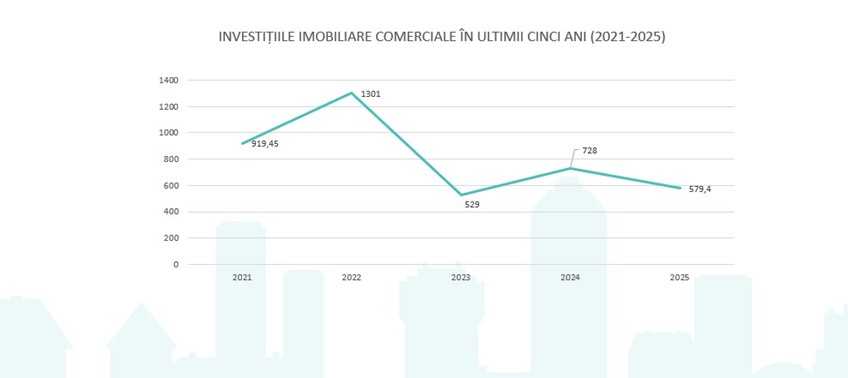
In 2025, the total volume of investments in commercial properties in Romania reached 579.4 million euro, according to a study conducted by Fortim Trusted Advisors, an alliance member of the BNP Paribas Real Estate.
Romanian investors held the largest share of total invested capital, accounting for 34% of transaction value, 193 million euro.

Second place was taken by investors from the United Kingdom, with 27% of the total and investments 156 million euro, followed by Hungarian investors with 9%, equivalent 52 million euro.

This structure marks a significant change compared to 2024, when Belgian investors ranked first, followed by Czech investors, while Romanian investors were in third place.

Among the most important commercial properties acquired by Romanian investors in 2025 are the Winmarkt Someș shopping center in Cluj-Napoca, the Joy retail park in Calafat, the Iride, Ethos, Pipera Business Tower and Henkel HQ office buildings in Bucharest, the Heineken factory in Constanța, as well as the Capitol hotel complex in Eforie Sud and the Balada Hotel in Saturn.

The significant increase in the share of Romanian investors reflects the maturation of the local market and growing confidence in the long-term potential of commercial real estate assets in Romania. We see well-capitalized local investors with clear strategies and an increased appetite for diversification, covering all four real estate segments: offices, retail, industrial and hotels,” said Ștefan Oana, Head of Capital Markets at Fortim Trusted Advisors, an alliance member of the BNP Paribas Real Estate.

A single investor from the United Kingdom, M Core, purchased retail parks and shopping malls in secondary cities with a total value ofeuro156 million, placing this nationality second in terms of total transaction volume.

TARA INVESTITORI VALOARE 2025 (MIL. EURO)
ROMÂNIA 193
MAREA BRITANIE 156
UNGARIA 52
ISRAEL 40
JAPONIA 35
LIBAN 30
TURCIA 15,8
BELGIA 15
CIPRU 6,4
GRECIA 4,2
n/a 20

Top 3 Transactions of 2025 

The largest transaction of 2025 was carried out by M Core, which acquired seven retail parks located in smaller cities for 57 million euro.
Second place was taken by a transaction involving Romanian capital: Alfa Group purchased part of the IRIDE office complex in the Pipera area of Bucharest for 55 million euro.
Third place was occupied by the Equilibrium transaction, acquired by Hungarian investors from Adventum for 52 million  euro.

One of the most important transactions expected in 2025 in the industrial segment—the acquisition of the P3 portfolio by CTP—did not receive approval from the Competition Council. Under these circumstances, the total investment market volume remained, at year-end, below the level recorded in 2024.

The largest transaction in the industrial segment was the acquisition of a tire factory in Mehedinți County for 35 million euro by a Japanese company.

In 2026, investor interest will remain high in the retail park segment, which continues to benefit from high occupancy rates, in the industrial-logistics segment, which has the greatest investment potential supported by the expansion of road infrastructure, as well as in the office segment. In this case, investors are particularly attracted by market opportunities generated by pricing levels and seller flexibility, if office assets are located in well-positioned areas,” estimates Nicolae Ciobanu, Managing Partner – Head of Advisory at Fortim Trusted Advisors, an alliance member of the BNP Paribas Real Estate.

The highest volume of investments ever made by Romanian capital in the real estate sector was recorded in 2022, when Pavăl Holding acquired office buildings with a total value ofeuro467 million. That year, Romanian investors accounted for 49% of the total transaction volume, in a context of record investment levels.

Market Reports

Market Reports 1600 1120 BUCHAREST REAL ESTATE CLUB

MARKET REPORTS: THE NEW FACE OF BUCHAREST (Coming Soon)

Bucharest will never be the same again. It is now a bold, vibrant and modern city whose facelift is definitively set by the latest Real Estate investments.

The newest BREC Report captures the most significant developments you should know about in Bucharest (2018 – 2022).

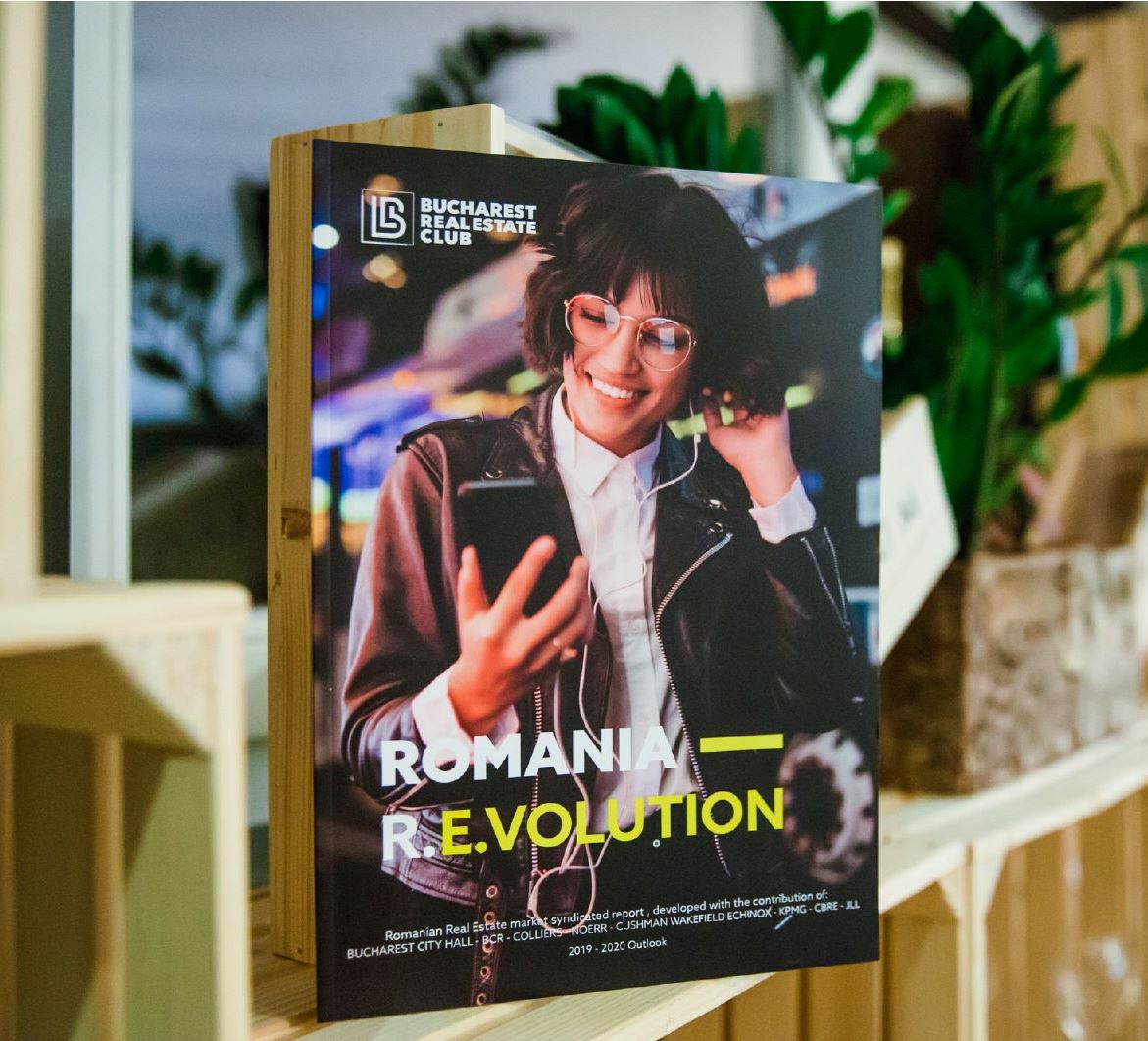
MARKET REPORTS: ROMANIA R.E.VOLUTION 2019-2020

The First Romanian Real Estate Market Syndicated Report, by BUCHAREST REAL ESTATE CLUB  

Developed with the valuable contributions of BCR, COLLIERS INTERNATIONAL ROMANIA, NOERR, CUSHMAN WAKEFIELD ECHINOX, KPMG ROMANIA, CBRE ROMANIA, JLL ROMANIA.

BUCHAREST REAL ESTATE CLUB_ROMANIA RE VOLUTION

Powerlists, rankings, macro and sectorial trends and analyses, market intel, opinions and key investors and consultants` outlook on the following 2 years are all comprised in BUCHAREST REAL ESTATE CLUB ROMANIA R.E.VOLUTION Report.

This is the first Romanian Real Estate Market Syndicated Report, a cohesive contribution of  BCR, COLLIERS INTERNATIONAL ROMANIA, NOERR, CUSHMAN WAKEFIELD ECHINOX, KPMG ROMANIA, CBRE ROMANIA, JLL ROMANIA, together with the latest data on the Bucharest infrastructure projects from the BUCHAREST CITY HALL.

Download the report
to read more on the following

Real Estate Market Trends (2019 – 2020)
KPMG Romania: Macroeconomic Outlook
Infrastructure: Bucharest City Hall main projects 2019-2020
Finance & Corporate Bonds
JLL Romania: Investment Market
Colliers International Romania: Office Market
CBRE Romania: Retail
Colliers International Romania: Industrial
Hotels
Residential
Noerr: The Legal Eye
Dragomir Bunea Notary Office: The Notary` View
To access the report please click on the bottom below 
Back to top