



10.02.2026
What are your company’s business targets and plans for 2026?
In 2026, our priority is to keep delivering long-term value through high-occupancy, high-performance, future-proof assets and to reach our next major milestone in Bucharest: the delivery of Timpuri Noi Square Phase 2, planned for Q4 2026. This is currently the largest office building under development in the city, adding over 60,000 sqm GLA and bringing the entire complex to 112,000 sqm GLA.
Our focus for 2026 is built around a few clear directions:
- Deliver Timpuri Noi Square Phase 2 on schedule and at top sustainability performance. The new building is designed as a landmark development that eliminates fossil fuels and relies on renewable sources, including 1,700 sqm of photovoltaic panels, heat pumps and geothermal wells. We are targeting LEED Platinum at the highest level (100+ points). Phase 2 also brings major facilities such as 690 underground parking spaces and an expanded retail mix, including New Tales, the largest food hall integrated into an office project in Romania, spanning nearly 6,000 sqm.
- Keep our existing portfolio highly competitive through tenant experience.
- Expand flexible leasing solutions such as Ready Flex Space.
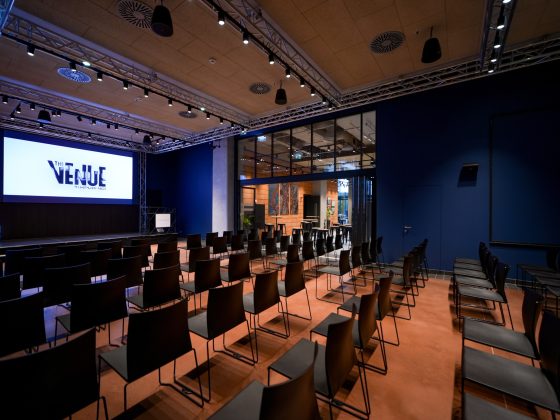
- Add new services that strengthen the ecosystem around our projects. This spring, we are launching The Venue, a fully equipped conference center with 400 sqm indoor space and an exclusive 300 sqm terrace, available both to our tenants and to companies outside our portfolio.
- Continue investing in communities, integrating our development into the city and supporting initiatives with measurable, long-term impact.
What were the main business results for 2025?
2025 confirmed a clear market direction: demand continues to concentrate in efficient, well-located, sustainable buildings, while quality and operational discipline are increasingly rewarded.
For us, the year delivered several strong results. Timpuri Noi Square Phase 1 reached 100% occupancy across its first three buildings, totaling 52,100 sqm, providing a solid foundation for Phase 2. We also officially launched Phase 2, with construction advancing significantly, structural works nearing completion and progress well underway on MEP, façade and finishing stages.
At Business Garden Bucharest, leasing activity remained strong, further validating the project’s green campus positioning. We also launched Ready Flex Space (2,321 sqm), which was almost fully leased shortly after delivery, underlining that flexible, high-quality office space is now mainstream demand.
Beyond commercial performance, 2025 was marked by concrete ESG action and community engagement, from supporting the Dâmbovița River revitalization to our blood donation initiatives, and by the completion of The Venue Timpuri Noi, further enriching the ecosystem around our projects.
What economic pressures or regulatory/fiscal changes do you anticipate impacting the market in 2026, and how is your company preparing for these?
In 2026, we expect the market to continue operating under the combined pressure of inflation, elevated financing costs and a tighter fiscal environment. Inflation remains relevant not only as a macro indicator, but because it directly affects occupier budgets, operating expenses and investment decisions.
Our response is pragmatic and long-term. We focus on developing and operating assets that can perform under higher cost pressure and stricter ESG requirements, through energy efficiency, electrification and predictable building performance. At the same time, we maintain very strong project controls and delivery discipline, because in a high-interest-rate environment, projects that deliver predictably and without compromise are the ones that stand out.
We also support occupiers in managing uncertainty by offering flexible leasing options and turnkey solutions, allowing them to move faster, reduce execution risk and still secure high-quality space.
What do you see as the main risks for the Romanian real estate market in 2026?
One of the main risks for 2026 is the impact of a tighter fiscal environment, which can affect investment appetite, financing conditions and overall development feasibility if not applied in a predictable and balanced way.
Another significant risk is the lack of clarity and consistency in urban planning and permitting frameworks. Uncertainty around urbanistic regulations can delay projects, increase costs and discourage long-term investment, particularly in complex, large-scale developments that require clear rules and stable timelines. More broadly, the market risks being affected by policy uncertainty rather than fundamentals. Romania continues to benefit from solid demand drivers, but sustaining healthy development activity will depend on fiscal and regulatory frameworks that support long-term, responsible investment rather than short-term adjustments
Where do you see the most attractive opportunities for growth in 2026?
The most attractive opportunities in 2026 are in projects that successfully combine strong location, operational efficiency, credible ESG performance and high-quality day-to-day occupier experience.
We also see renewed opportunity in the return of forward-looking commitments, including pre-leases, as occupiers respond to constrained development pipelines and seek to secure space earlier, before options narrow. Low delivery volumes and evolving vacancies are creating the conditions for a more proactive leasing cycle.
Beyond that, we see growth in “ecosystem” assets, meaning office destinations that integrate amenities, services, and community features that support attendance, retention, and tenant engagement, not just a workplace footprint. And, on a wider horizon, infrastructure improvements can gradually reshape corporate location strategies, creating new pockets of demand where connectivity improves, so we keep a close eye on where those shifts are happening and how they translate into real occupancy and leasing momentum.